
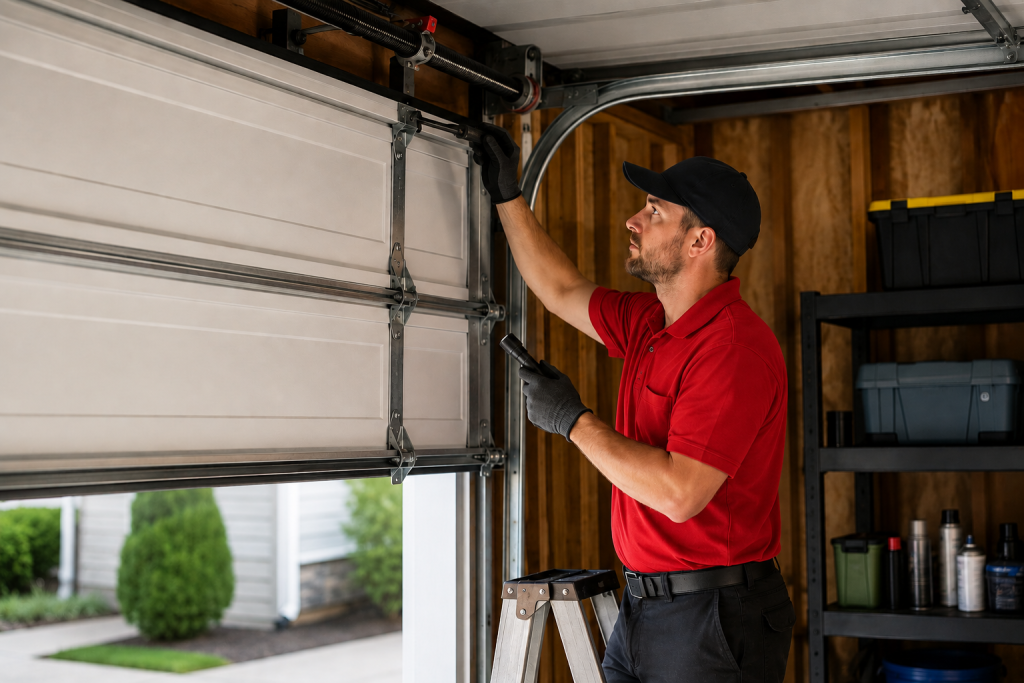
A garage door usually gets very little attention when everything is working normally. Then one morning, it refuses to open, makes a loud noise, or starts moving unevenly.
Regular garage door maintenance can help you catch warning signs before they become bigger problems. It also gives homeowners and business owners a chance to spot issues that should be handled by a trained technician.
The key is knowing what you can safely look at yourself and what should be left to a professional.
How Often Should You Perform Garage Door Maintenance?
There isn’t one maintenance schedule that applies to every garage door.
A residential door that opens a few times a day has different demands than a commercial door that operates throughout the workday. The manufacturer’s maintenance instructions should always be the starting point for your specific door.
For homeowners, a basic visual and operational check can be part of regular home maintenance. DASMA’s residential garage door checklist gives homeowners and inspectors a practical framework for checking the condition and operation of a sectional garage door and opener.
Commercial doors deserve their own maintenance schedule. For example, DASMA’s guidance for rolling doors recommends periodic inspection and maintenance by a trained door systems technician at least annually, or according to the manufacturer’s recommendations.
A good rule is simple: check your door regularly, follow the manufacturer’s maintenance schedule, and don’t wait for a failure before addressing obvious problems.
Garage Door Maintenance Checklist for Homeowners
You don’t need special tools or technical training to notice many common warning signs.
A visual inspection can help you identify changes that deserve professional attention.
1. Look at the Door Panels
Start with the door closed and look at the panels from inside and outside the garage.
Check for:
- Cracks
- Dents
- Buckling
- Separation of materials
- Signs of impact
- Damaged windows or glass
DASMA’s consumer inspection checklist specifically recommends looking at the door sections and checking for cracks, fatigue, separation, and other visible damage.
A small cosmetic dent may not require immediate service. Structural damage is another matter. If the door looks different from the way it normally does, have it inspected before assuming it is safe to keep operating.
2. Watch the Door While It Moves
Pay attention when the door opens and closes.
Does it move smoothly? Does one side appear to move differently from the other? Does it stop, hesitate, shake, or make a new noise?
Those changes are worth noting.
A properly operating door should not suddenly become difficult or uneven to move. If you notice a change, don’t keep cycling the door to see if the problem goes away.
3. Check the Tracks From a Safe Position
Look at the tracks and surrounding hardware without attempting to adjust anything.
Watch for obvious signs of:
- Misalignment
- Damage
- Loose hardware
- Obstructions
- A roller sitting outside the track
DASMA’s inspection guidance includes checking the track system, rollers, brackets, hinges, and other visible components.
If a track looks bent or a roller has come out, that’s a reason to stop and call a professional rather than trying to force the door back into place.
4. Look at the Cables and Springs, But Don’t Touch Them
This is one of the most important lines to draw during DIY garage door maintenance.
You can look at springs and cables from a safe distance. You should not adjust, remove, or repair them.
Garage door springs and related hardware can be under extreme tension. DASMA specifically warns homeowners not to attempt spring repairs or adjustments and recommends having repairs performed by a trained door systems technician.
If you see a broken spring, loose cable, or other obvious problem with the counterbalance system, leave the door alone and call for service.
What About Garage Door Lubrication?
Lubrication is often mentioned as a basic part of garage door maintenance, but homeowners should follow the manufacturer’s instructions for the specific door and components.
Using the wrong product or applying too much can create its own problems.
The same applies to tightening hardware or adjusting components. A garage door is a system, and changing one part can affect how another part operates.
When in doubt, ask a garage door professional what maintenance your particular system needs.
Don’t Forget the Garage Door Opener
The door itself isn’t the only part of the system that needs attention.
The opener also deserves a regular check.
Listen for changes in its normal operation. Pay attention if it becomes unusually noisy, slow, inconsistent, or unresponsive. Check that the wall control and remote are working normally.
The safety features are especially important.
DASMA’s guidance states that safe operation depends on a properly balanced door, an effectively working operator, and working entrapment protection.
Homeowners should follow the opener manufacturer’s instructions when checking safety features. If something doesn’t work as expected, stop using the system and contact a trained technician.
A Simple Monthly Garage Door Maintenance Checklist
For homeowners who want something easy to remember, keep this short checklist handy:
Homeowner Check
- Look over the door panels for visible damage
- Watch the door open and close
- Listen for new or unusual sounds
- Look for obvious track or roller problems
- Check cables and springs visually from a safe distance
- Check the opener and wall control
- Pay attention to changes in normal operation
- Follow the manufacturer’s maintenance instructions
This is an observation checklist, not a repair guide.
If something looks wrong, don’t start taking the door apart to find the cause.
Commercial Garage Door Maintenance Needs More Planning
Businesses have another reason to stay ahead of maintenance: downtime.
A garage door at a warehouse, service facility, loading area, or commercial property may operate far more often than a residential door. A failure can interfere with deliveries, employee access, vehicles, and normal business operations.
Property managers should keep a record of:
- When the door was last serviced
- Any repairs that were completed
- Recurring problems
- Unusual operating behavior
- Damage from vehicles or equipment
- Manufacturer maintenance recommendations
This makes it easier to spot patterns.
If the same commercial door needs repeated repairs, for example, it may be time to have the entire system evaluated instead of continuing to address individual problems.
Commercial Garage Door Maintenance Checklist
Business owners and property managers can use a similar checklist:
- Check doors for visible impact damage
- Watch each door operate
- Listen for changes in normal operation
- Look for damaged tracks or rollers
- Check visible hardware for obvious problems
- Look for signs of cable or spring problems without touching them
- Check operator controls
- Review the service history
- Follow the manufacturer’s maintenance schedule
- Schedule professional inspections as recommended
For commercial rolling doors, DASMA recommends periodic inspection and maintenance by a trained door systems technician at least annually, or according to the manufacturer’s recommendations.
When Should You Call a Garage Door Professional?
Knowing when to stop inspecting and call for help is just as important as knowing what to check.
Call a professional if you notice:
- A broken spring
- A loose or damaged cable
- A door that has come off its track
- Significant panel or structural damage
- A bent track
- A door that is suddenly very difficult to move
- Uneven movement
- A door that won’t open or close properly
- Problems with the opener or safety features
- Damage caused by a vehicle or other equipment
DASMA’s residential checklist instructs homeowners to contact a trained door systems technician when problems are found during the inspection. It also specifically warns against attempting repairs or adjustments to springs and related components.
If your garage door needs professional attention, Salem Overhead Door provides garage door repair throughout Salem and the surrounding North Shore communities.
Don’t Wait for a Broken Door to Start Thinking About Maintenance
Garage door maintenance doesn’t have to become another complicated chore on your home or property management list.
The most useful habit is simply paying attention.
If your door sounds different, moves differently, or shows visible damage, don’t ignore it. A professional can determine whether the problem needs immediate repair or whether a component can be monitored during routine service.
For businesses, scheduled maintenance can also help reduce the chance of an unexpected interruption. For homeowners, it can help keep a heavily used part of the house operating properly.
A Little Maintenance Can Go a Long Way
A garage door is a large moving system with many individual components. Regularly checking its visible condition and operation is a simple way to stay ahead of problems.
The important part is knowing where your responsibility ends. Homeowners and business owners can look, listen, and notice changes. Springs, cables, tracks, and other mechanical components should be handled by trained professionals when repair or adjustment is needed.
If you are due for service or have noticed something unusual, Salem Overhead Door offers emergency garage door repair when a problem can’t wait.
For homeowners and businesses throughout Salem, Beverly, Peabody, Marblehead, and the surrounding North Shore, regular garage door maintenance can be a much easier task than dealing with a door failure at the worst possible time.